Macroecology and Macroevolution of Naturalized Alien Plants
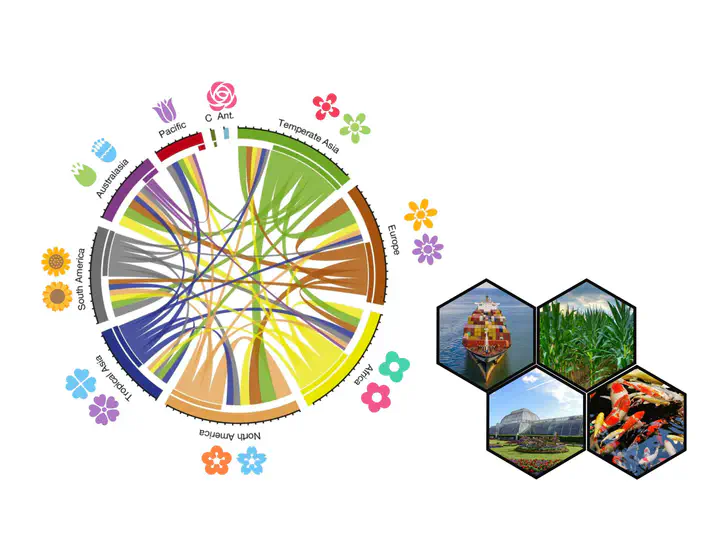
As a consequence of the human-facilitated exchanges of alien species and the resulting biological invasions, the uniqueness of regional biotas may be vanishing. However, to what extent regional floras have lost their uniqueness due to alien species has not been quantified at the global scale yet, and we also do not know how variation in floristic homogenization (the increase in floristic similarity) relates to biogeographic and anthropogenic factors. When I worked as a postdoctoral research at the Unversity of Konstanz with Professor Mark van Kleuen, my project mainly aimed to fill this research gap by combining a global database of native plant inventories (GIFT) with one of naturalized alien plant inventories (GloNAF).
Although the naturalization and invasion of alien species poeses a huge threat to the biodiversity and functioning of ecosystems, the factors that determine naturalization success and geographical patterns therein, and which are key to predicting and preventing future alien invasions, remain poorly understood. Phylogenetic relatedness between alien species and the native species in the recipient region can serve as a surrogate for the similarity in their traits and partly reflect the environmental similarity between the original region of the alien species and the recipient region. I has also worked to understand the role of the alien-to-native phylogenetic relatedness in determining naturalization success of alien species.

Qiang Yang 杨强
My research interests include ecological networks, biological invasion and global changes.